
How a solar panel machine price is built: the four variables that set it, where the money sits inside a line, and why suppliers quote per project.
Quick answer: There is no published unit price for a solar panel production line, and that is not evasion — a machine price is assembled from four variables that change with your specification. First, the cell format and busbar count the machine must handle. Second, the automation level, which decides whether handling is manual or servo-driven. Third, the station scope included in the quote. Fourth, the throughput you specify, since a faster machine is a different machine rather than an upgraded one. Inside a line, cost is concentrated in the stringer, laminator and testing equipment; framing and handling stations cost far less but still consume floor area. A machine price normally excludes building works, power infrastructure, installation, consumables and certification, which together are a significant share of total project cost.
No equipment supplier publishes a price list for a solar panel production line, and that is not evasion. A machine price is built from four variables that change with your specification. Understand them and you can read any quotation, including ours.
PV Module Manufacturing · Equipment Cost & Budgeting · by Jerry, Ooitech
1. What Actually Sets a Machine's Price
Four variables explain almost the whole spread between the cheapest and the most expensive machine that does the same job on a line. None of them is the supplier's margin.
| Variable | Why it moves the price |
|---|---|
| Throughput | Cells per hour and panels per hour. Raising rated speed means more heads, more servos and a heavier frame, not a software change. |
| Automation level | A semi-automatic framing machine and a fully automatic one do the same job on paper. The price gap buys labour reduction and repeatability, not capability. |
| Cell format range | A machine that handles one cell format only is cheaper than one covering 5BB to 24BB and 156 to 210 mm half-cut cells. Wider compatibility costs more. |
| Inspection and control | Camera count, view-check function, inline EL and glue-flow control add cost, and they are the options most often cut from a first budget. |
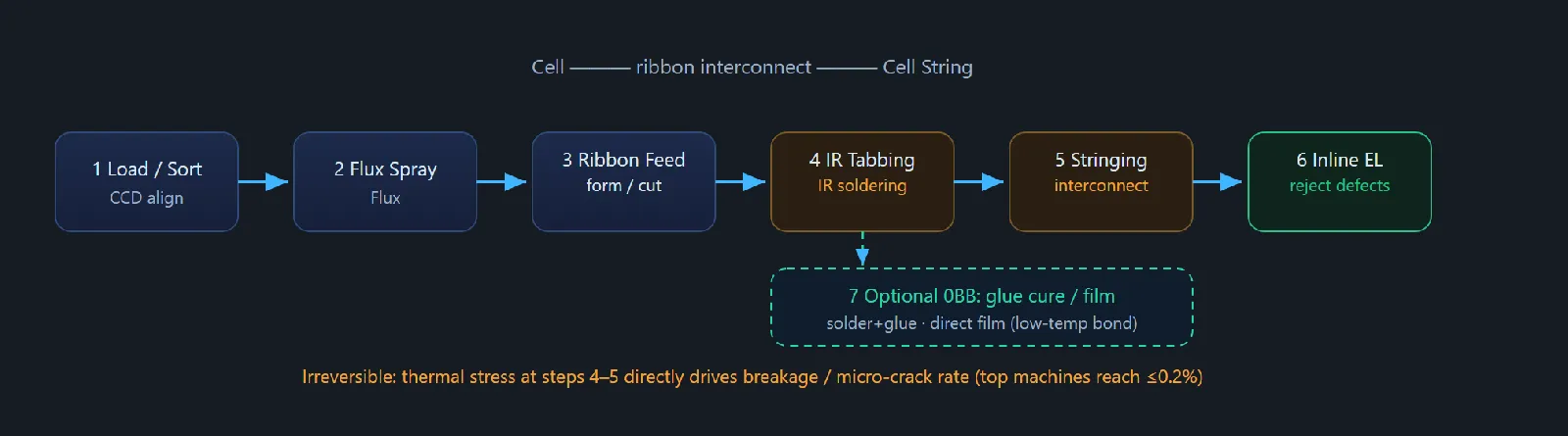
Fig. 1: Why the stringer is the most expensive station. Steps 4 and 5 apply thermal stress to the cells, and that stress sets the breakage and micro-crack rate the rest of the line inherits.
2. Where the Money Sits Inside a Line
Percentages travel better than figures, because they stay meaningful whatever the line size or quotation date. The shares below come from Ooitech quotation sheets across semi-automatic and fully automatic lines, and they are remarkably stable.
| Station | Typical share of machine budget | Why |
|---|---|---|
| Tabber stringer | 30 – 40% | Highest head count, highest precision, and on large lines it may be supplied with an integrated cell cutter |
| Laminator | 25 – 35% | Vacuum pumps, heated chambers and chamber size. This is the single heaviest piece of equipment on the floor |
| Layup and bussing | 10 – 20% | Wide range: a manual layup station and an automatic bussing-and-layup station sit at opposite ends of the same line item |
| Testing: EL, IV and cell test | 10 – 20% | Camera count and simulator class drive this, and most lines carry two EL stations |
| Framing and junction box | 5 – 15% | Low for semi-automatic, high once automatic framing and glue-flow control are specified |
| Cutting, loading and handling | 5 – 12% | Cell laser cutting, EVA film cutting, glass loaders, carriers and the air system |
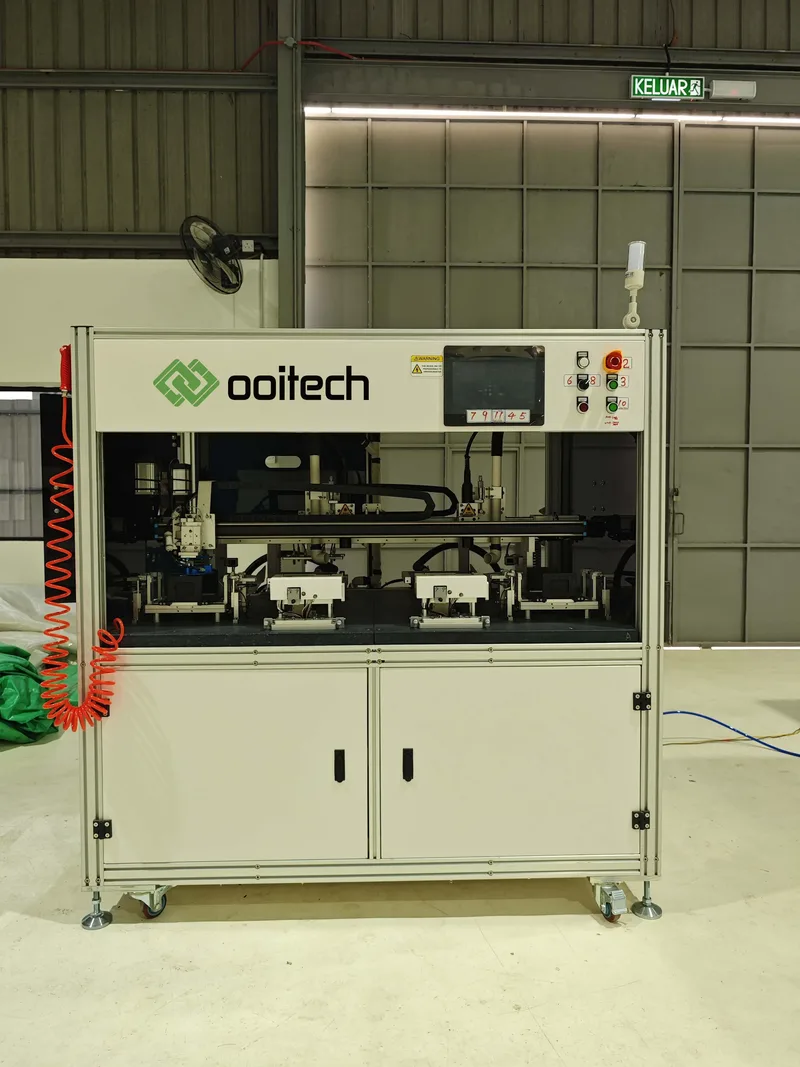
Fig. 2: An Ooitech stringer on a customer line. It is usually the largest single line item in the quotation, which is why it deserves more of your evaluation time than anything else on the list.
3. The Same Machine at Three Price Levels
The stringer shows most clearly that specification, not supplier, sets the price. Our own quotations contain three tiers of the same function, and the differences are visible in the specification rather than the price.
| Tier | What defines it | Best fit when |
|---|---|---|
| Entry | Semi-automatic, camera assisted alignment, one or two cell formats, throughput counted in hundreds of cells per hour | Semi-automatic line, one or two shifts, module formats already fixed |
| Standard | Fully automatic, roughly 2,400 cells per hour, 156 to 210 mm and 3BB to 20BB coverage | Continuous flow where throughput matters more than format flexibility |
| High output | High-speed platform with an integrated cell cutter, removing a separate handling step | 150 MW and above, where fewer cell handoffs measurably reduce micro-cracking |
Note what the entry tier does not give up. A semi-automatic stringer still solders every joint to the same standard. What the higher tiers buy is integration and fewer handoffs, and handoffs are where micro-cracks are created. That is the real argument for paying more, and it is an argument about yield rather than about speed.
4. Why There Is No Published Unit Price
Three reasons, and they apply to every serious equipment supplier, not only to us.
| Reason | Detail |
|---|---|
| One name, many machines | "Tabber stringer" covers everything from a semi-automatic bench unit to a high-speed platform with an inbuilt cutter. Publishing one number would mislead more than it informs. |
| Configuration moves the price | Camera count, view-check, glue-flow control and cell format coverage are chosen per project. A fixed list price would be wrong for most buyers on the day it was published. |
| Cost inputs move | Components, servo and laser pricing, and ocean freight all shift. A dated quotation is the only honest way to quote equipment with a long build cycle. |
What you can and should ask for instead: a station-by-station breakdown, the model number behind each line, and a clear statement of what is excluded. Those three things let you compare two quotations properly, which a headline price never does.
5. What the Machine Price Does Not Include
Our standard commercial terms appear on every quotation sheet. They define the boundary of the machine price.
| Item | Standard term |
|---|---|
| Price basis | FOB Shanghai. Freight, insurance, import duty and local taxes are not included. |
| Payment | 30% T/T deposit, remaining 70% by T/T before shipping. |
| Delivery | About 35 to 40 days after the down payment for smaller semi-automatic lines; longer for full automatic lines. |
| Installation and training | Online technical support and drawing design are included for your engineers. On-site commissioning is scoped separately. |
| Raw materials | Cells, ribbon, encapsulant, backsheet, glass and frames are quoted separately. A line price is not a factory budget. |
The last row is the one that catches first-time buyers. Machine cost is a one-time number. Raw material cost per watt recurs every month and decides whether the factory is competitive, which is why we supply both and prefer to model them together. Published line totals by capacity, taken from dated quotation sheets, are on the solar panel production line cost by capacity page so you can size the overall investment before drilling into machines.
6. FAQ
How much does solar panel manufacturing equipment cost?
It scales with capacity rather than following a rate per megawatt, because the same bottleneck machines appear on small and large lines at different specifications. Published totals by capacity, built from our dated quotation sheets, are on the production line cost page. Within any line, the stringer and the laminator together account for roughly 55 to 75 percent of the machine budget.
Which machine is the most expensive?
The tabber stringer, in almost every configuration we quote, followed by the laminator. On large lines the stringer may come with an integrated cell cutter, which moves it further ahead of everything else on the list.
Why can two quotations for the same capacity differ so much?
Usually three things: which stringer tier is offered, how many EL cameras are included, and whether the second-glass loader and automatic bussing are inside the scope. Ask both suppliers for a station-by-station breakdown before comparing totals.
Is a cheaper machine a false economy?
On the stringer and the laminator, usually yes. Those two set the crack rate and the encapsulation quality that every downstream station and every warranty claim inherits. On framing, carriers and manual stations, a lower-cost specification rarely changes the module you ship.
Can I buy machines one at a time instead of a whole line?
Yes, and many first-time factories do. The risk is balance: a machine bought in isolation is specified for its own throughput, and a line runs at the speed of its slowest station. Size each purchase against the line you intend to end up with, not the one you have today.
What payment terms do you use?
Our standard terms are 30% T/T deposit with the balance of 70% by T/T before shipping, and delivery about 35 to 40 days after the down payment for smaller semi-automatic lines. Larger automatic lines take longer and are scheduled per project.
How much does solar panel equipment cost?
Equipment cost scales with capacity and with the degree of automation, and the two are not independent. A semi-automatic workshop line and a fully automatic line of the same nameplate capacity can differ by a factor of two or more, because the automatic version buys you handling, vision alignment, inline testing and the labour reduction that goes with them.
Within a line, cost concentrates in a few stations rather than spreading evenly: the stringer, the laminator and the testing stations carry most of the value, while framing, trimming and conveying are comparatively modest. That distribution is useful when budgeting, because it tells you where downgrading a specification actually saves money and where it simply moves cost into yield loss.
What is the price of a solar structure making machine?
There is no single answer, because “solar structure making machine” describes several different products. It can mean a module assembly line, a mounting structure or bracket production line, or an individual station such as a framing machine or a cutting machine. Each has its own price logic and its own capacity range, and comparing them as if they were one category is the most common source of confusion in this area.
The reliable approach is to name the process you need to perform, the material and the throughput, and ask for a scope rather than a price. A framing machine priced alone and a framing station inside a line are not the same purchase: the standalone unit needs its own infeed, controls and safety enclosure, and those are already inside the line price.
Final Thoughts
Read a machine price as a ladder, not a list. The stringer and the laminator decide what your factory can produce and how many panels it rejects; everything else supports them. Ask for the quotation broken out station by station, check which stringer tier and how many EL cameras you are being offered, and confirm whether installation, raw materials and duties sit inside or outside the number. Send us your target capacity, module size and cell format, and we will return a station-by-station quotation for that specification rather than a generic total.