
A practical breakdown of lightweight solar modules for weak rooftops and structures, comparing pure flexible panels, lightweight aluminum-frame modules
Quick answer: A lightweight solar module is defined by what the mounting structure can carry, not by an arbitrary weight figure. China has a large stock of industrial and commercial roofs where the structure was never designed for a conventional glass-glass or glass-backsheet module, so the usable module weight is set by the roof's remaining load margin rather than by the product catalogue. Achieving a lower weight comes from reducing glass thickness, using a lighter frame profile or removing the frame entirely, and selecting a lighter backsheet. Thicknesses in the 6 mm and 4.75 mm class appear in the module constructions discussed, against a conventional front glass of 3.2 mm or more. Each reduction trades mechanical load rating and impact resistance, so the specification has to start from the roof it will sit on.
PV Module Manufacturing · by Jerry, Ooitech
Product Introduction
China has a huge stock of industrial and commercial sites where the roof or structure just can't take much extra load. A standard PV module weighs around 10.6kg per square meter. Plenty of old color steel roofs and special structures can't hit that number, so you simply can't lay standard panels on them.
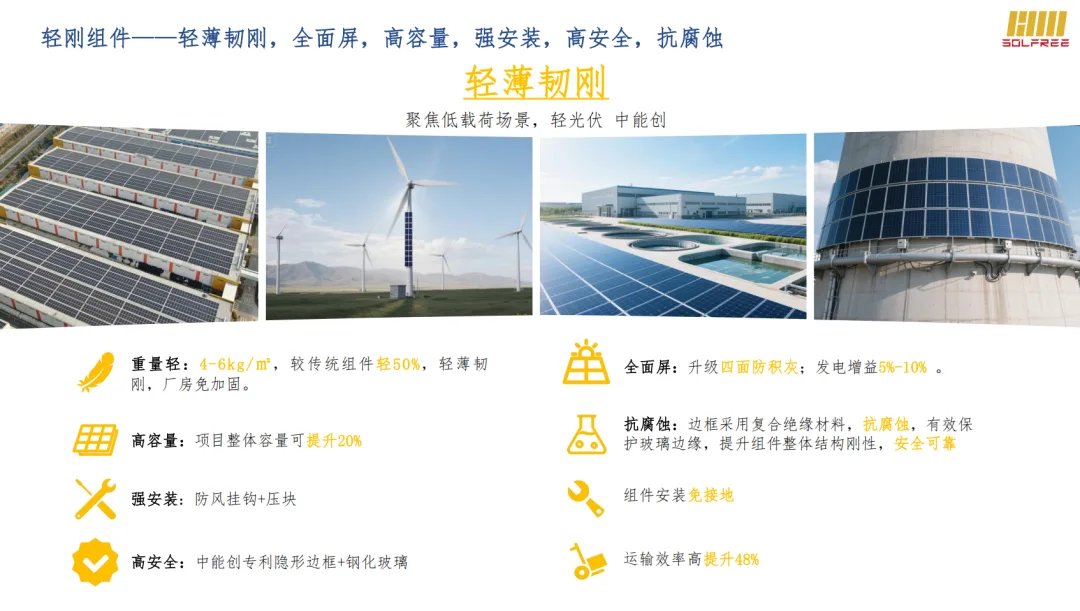
That's where lightweight modules come in. The use cases are wide: color steel factory roofs, building facade PV, flexible mounting over wastewater pools and sewage treatment stations, curved roofs, non-walkable roofs, carport canopies, PV curtain walls, and more. By some estimates the domestic demand for lightweight modules runs into tens of gigawatts.
Look back at how this played out. Early players who bet mainly on flexible lightweight modules, like Ritek and SunMan, have all but disappeared. A lot of their early projects showed reliability problems too. Pure flexible modules have clear weak points in these scenarios, but the market demand is still there. Against that backdrop, Zhongnengchuang rolled out its "rigid-light PV module" and became a leader in this niche.
Why Pure Flexible Modules Fail in These Scenarios
The two fatal shortcomings of glued-down flexible panels
Traditional flexible modules drop the tempered glass front sheet and mostly rely on adhesive to bond the whole panel flat onto the base surface. This fully glued-down install has two killer flaws.
First, the module sits tight against the base with no ventilation gap. Heat dissipation is terrible, working temperature climbs noticeably, and power degradation speeds up.
Second, once a hot spot shows up in that sealed bonded structure, the heat has nowhere to go, so fire risk goes up clearly. On top of that, without a tempered glass protective layer, resistance to hail and UV aging is weak. Run it outdoors long term and it tends to bubble and delaminate, so maintenance risk is high.
Technical Parameters
Rigid-light module vs conventional lightweight module
Take LONGi's Hi-MO X10 lightweight module as an example. Both belong to the lightweight category, but the underlying tech routes are very different.
| Item | LONGi Hi-MO X10 Lightweight | Zhongnengchuang Rigid-Light |
|---|---|---|
| Design route | Lightweight aluminum-frame refinement | No aluminum frame, ultra-thin composite full-wrap edge |
| Frame | Anodized aluminum alloy frame | Removed |
| Glass | 1.6mm semi-tempered glass | Ultra-thin composite full-wrap edge |
| Weight | 16.3 ± 3.3 kg | Lower areal weight |
| Dimensions | 1990 x 1134 x 30 mm | Overall thickness only 4.75 mm |
| Areal weight | About 7.2 kg/m² | As low as 5.91 kg/m² |
| Mounting | Mainly clamp fixtures, not suited to large-area gluing | Back hooks + rack, or glued to color steel / square steel |
LONGi's version leans on the aluminum profile for mechanical protection. The tech is mature and it installs mainly with clamp fixtures, which doesn't suit large-area gluing.
Zhongnengchuang's rigid-light module drops the heavy aluminum frame and uses a 4.75mm ultra-thin composite full-wrap edge. Overall thickness is only 4.75mm and areal weight drops to 5.91kg/m², about 18% lighter than LONGi's lightweight module. Mounting can be back hooks plus a rack, or glued onto color steel or square steel.
Zhongnengchuang rigid-light module VS conventional lightweight module
Technical Advantages
Product Application
This kind of lightweight module targets the large stock of sites with limited residual load capacity. Typical applications include color steel factory roofs, building facade PV, flexible mounting over wastewater pools and sewage treatment stations, curved roofs, non-walkable roofs, carport canopies, and PV curtain walls.
Installation guide
Ooitech's View
The honest takeaway here is that weight alone was never the whole story. The pure-flexible generation lost the market because they gave up the rigid protection and ventilation that keep a module alive outdoors for 20-plus years. A 4.75mm wrapped edge that still lets you glue onto color steel or hang off a rack is a smart middle path. From a manufacturing side we see the same trend on our production lines, thinner glass and frameless designs demand tighter lamination and framing control, so process stability matters as much as the bill of materials. If you want to see how these lightweight and frameless lines actually run on the floor, the Ooitech YouTube channel at www.youtube.com/ooitech is worth a subscribe.