
A practical look at how cold solder joints inside a solar module junction box can lead to bypass diode breakdown, burnout, and even DC arcing
Quick answer: Cold solder joints at the junction box are a defect class that process engineers at module factories recognise immediately, because the joint is made at the very end of the line where a failure means the whole module is lost. The cause is usually thermal rather than mechanical: the soldering iron or head is at the correct set temperature, but the joint does not reach it long enough for the solder to wet and alloy properly, so the connection looks complete and measures acceptably in a continuity check while having a fraction of the intended contact area. That kind of joint passes final test and fails in the field under thermal cycling. The inspection answer is not visual — it is a controlled soldering profile with verified time and temperature at the joint, plus pull or peel testing on a sample basis.
PV Module Manufacturing · by Jerry, Ooitech
Product Introduction
A lot of process engineers at module factories will tell you the same thing. On the junction box side, you only solder the busbar and the copper strip, so even a cold solder joint won't break down or burn out the diode.
Sounds reasonable at first, right? But they're missing one important chain reaction. Let me walk through it.
First, what exactly is a cold solder joint in a junction box?
A junction box cold solder joint (virtual soldering) is a defect where the internal electrical connection isn't soldered solidly and has poor contact. The joint isn't fully open. The contact area just shrinks, so local contact resistance goes up sharply. When current passes through this high-resistance point, it generates a lot of Joule heat, and the local temperature climbs fast.
Technical Parameters
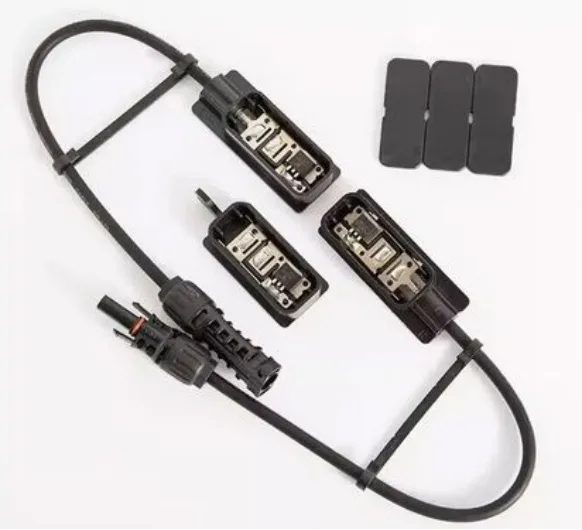
Cold solder joints in a junction box usually show up at one of four spots: the diode lead to copper conductor connection, the busbar to copper conductor connection, the lead-out wire solder point, and the solder points between internal copper conductors, tin blocks and other conductive modules. These four fall into two groups: diode branch cold solder (spot one) and main loop cold solder (spots two, three, four).
| Fault Type | Location | Working Condition | Result |
|---|---|---|---|
| Diode branch cold solder | Diode lead to copper conductor (spot 1) | No shading, no hotspot | No current through the branch, joint stays cool, diode normal |
| Diode branch cold solder | Diode lead to copper conductor (spot 1) | Shading, crack or degradation | Bypass diode conducts, high current through the joint, violent heating, diode thermal breakdown |
| Main loop cold solder | Busbar / lead-out / internal conductors (spots 2,3,4) | Full-current operation | Joint heats continuously, bakes the diode, reverse leakage and overcurrent capability drop |
Technical Advantages
Product Application
Once the diode is broken down and burnt, it can go a step further and set off DC arcing, with temperatures reaching up to 3000°C. That finally torches the junction box and can start a module fire.
So during PV plant operation, checking for junction box cold solder joints on time really matters. You can scan the junction box area with an infrared thermal camera. A cold joint or an abnormally hot diode will show up as an abnormal high-temperature spot on the thermal image. Repair or replace it right away and you stop the fault from spreading, keeping the module running stable.
Ooitech's View
What this really shows is that junction box reliability is decided long before the plant goes live, right on the production line where those diode and busbar joints get soldered. Weak soldering here doesn't fail today, it fails years later under the first bad hotspot, which is why controlling solder quality on module equipment matters as much as any cell tech. On our own turnkey module lines we treat junction box and bussing soldering as a hard checkpoint, not an afterthought. If you want to see how proper module assembly and soldering is done, the YouTube channel www.youtube.com/ooitech has plenty of real factory footage worth a look.