
Most US modules are imported. How tariffs reshaped routing rather than ending dependence, why cell capacity stays concentrated, and the case for building locally.
The United States gets most of its solar panels from Asia, and the largest share has for years come from Southeast Asia — Vietnam, Malaysia, Thailand, and Cambodia — because Chinese cell and module manufacturers built assembly plants there to serve the US market from outside the direct China duty perimeter. India and South Korea are also meaningful suppliers, alongside a smaller but growing volume of modules assembled inside the United States from imported cells. The honest summary is that the US imports the majority of the modules it installs, and the countries it imports from have changed several times in a decade without the underlying dependence changing at all. Capacity moved to the next country; it did not come home.
For someone weighing whether to build capacity rather than buy containers, the interesting part is the asymmetry underneath the country list. Module assembly is mobile: light capital equipment, months to commission, portable when a duty order lands. Cell manufacturing is not mobile: heavy capital, cleanrooms, diffusion furnaces and a specialized supplier base that nobody relocates quickly. The US now assembles far more modules than it did five years ago and still does not make most of the cells those modules need. That gap is the whole story, and it is why a module line running on imported cells is a normal business plan rather than a compromise.
Treat any specific figure with caution first, because this is the one subject in solar where a confident sentence from last year is often wrong today: tariff rates, country shares and the status of specific measures change on a timescale of months. What follows describes structure and mechanism, which are durable. Every number you intend to act on must be verified against current sources — the Federal Register, US Customs and Border Protection, the Department of Commerce, the International Trade Commission and the US Energy Information Administration — before it enters a business case. Nothing here is a current tariff schedule.
Where Does the US Get Its Solar Panels From?
The market is supplied from four buckets. First, Southeast Asia, which became the largest source because Chinese manufacturers built module assembly in Vietnam, Malaysia, Thailand and Cambodia and shipped from those plants into the US. Second, India, whose own manufacturing base expanded fast enough to leave exportable volume. Third, South Korea and other established producers with long-standing cell and module operations. Fourth, domestic US assembly, which is real and growing and still depends on imported cells for most of its input.
The ranking of those buckets is not stable, and the cause is not demand. It is enforcement. When a duty order, a tariff expansion or a detention pattern makes a route expensive or slow, volume re-routes through whichever origin is cheapest and cleanest to document that quarter. The country list keeps changing while the import share stays high, which is why a sourcing plan anchored to one origin is really a bet on a decision made in Washington.
The concentration is also asymmetric between the two products. Modules are assembled in many countries. Cells are made in very few. A tariff that blocks one assembly origin can be answered by standing up an assembly plant somewhere else in under a year. Nothing equivalent can be done about cells, because cell capacity is where the capital, the process know-how and the qualified equipment base actually live.
From Which Countries Did the US Import Solar Panels in 2025?
The defensible answer is that 2025 continued the previous several years of pattern: Southeast Asia supplied the largest share of imported modules, India and South Korea remained significant, and domestic US assembly absorbed a growing but still minority share of the market. Customs and Census trade data will let you rank specific countries for a specific month, and that is where the ranking should come from rather than from any article, this one included.
What matters more is the mechanism that produced it. The China AD/CVD orders in force since 2012 pushed module assembly out of China into Southeast Asia. The 2018 Section 201 safeguard applied a tariff-rate quota to imported cells and modules from all origins, which made origin-shopping profitable without making imports uncompetitive. Section 301 tariffs raised the cost of Chinese-origin goods specifically. AD/CVD orders later extended to several Southeast Asian producers turned the alternative route from a loophole into a risk, and the Uyghur Forced Labor Prevention Act added a documentary condition that applies regardless of origin.
Every one of those instruments had the same practical effect. It changed the cost or the paperwork of a route, and the route moved. A measure rarely ends the import; it relocates it. After enough rounds, the map of where the US buys panels reads less like a supply chain and more like a record of which countries faced which order in which year.
Why Southeast Asia Became the Largest Source
Southeast Asia became the largest source for a structural reason rather than a geographic one: the cells, the process engineering and the equipment relationships were already Chinese, and a module plant in Vietnam or Malaysia was a straightforward extension of an existing operation. Module assembly is the least capital-intensive step in the chain and its equipment is standardized, so capacity could be replicated in a new country by the same engineering team that built the last one. The full regional picture, including why India and Korea followed different logic, is in where solar panels are manufactured.
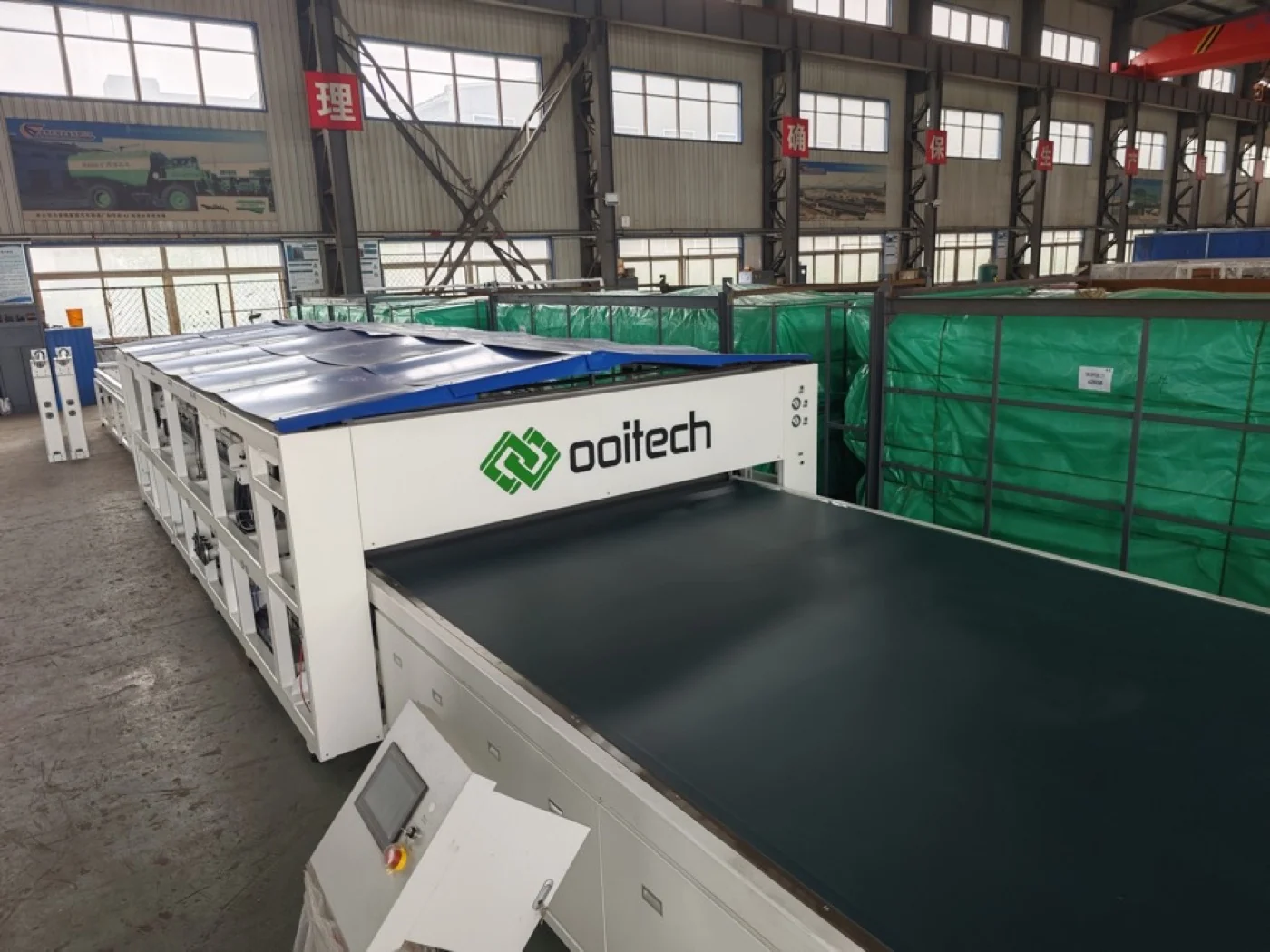
This is the kind of module assembly equipment that can be replicated wherever policy makes final assembly attractive.
Cells Are Far More Concentrated Than Modules
This is the structural fact that decides whether any trade measure can work, and it is worth stating before the mechanics. The regional distribution behind it is covered in the geography of module and cell production; what matters here is the consequence for tariffs.
Module assembly is a mechanical and thermal process: solder, lay up, laminate, frame, test. Cell manufacturing is a semiconductor process: texturing, doping, junction formation, passivation, metallization, firing. One can be learned from a line supplier and a production team in a single project. The other needs a qualified workforce, a clean environment, tightly controlled consumables and a long commissioning curve.
That difference in difficulty is why trade measures move assembly and cannot move cells. When duties made Chinese modules expensive, assembly appeared in Vietnam, Malaysia, Thailand and Cambodia, and later in the US. Cell capacity did not follow, because the barrier was never the tariff. It was capital intensity, process yield, and the supply of the specific equipment, pastes and screens a cell fab consumes.
The consequence is the important part. Global cell capacity sits in a small number of hands, mostly in China or in Chinese-affiliated operations elsewhere, so every module producer outside that group buys cells from the same small set of sellers. Localizing assembly does not localize supply security; it relocates the last step and leaves the critical input where it was. A buyer who understands this stops asking which country their modules come from and starts asking who makes the cells inside them.
How Tariffs, AD/CVD, and the UFLPA Reshaped Routing
Four instruments explain most of the routing history. The Section 201 safeguard applied a tariff-rate quota to imported cells and modules from all origins: a quantity enters at a lower rate, and volume above that threshold faces a higher one. Section 301 tariffs added duties on a long list of Chinese-origin goods, raising the cost of the direct route and making third-country assembly more attractive. AD/CVD orders are product- and country-specific, and they are the instrument that periodically converts a popular alternative origin into a liability. The UFLPA is not a tariff at all: it creates a rebuttable presumption that certain goods are made with forced labor, shifting an evidentiary burden onto the importer and stopping shipments where duty rates never would.
Two features are commonly missed. First, the instruments stack. A module can face a safeguard tariff, an AD/CVD cash deposit, Section 301 duties on inputs and a UFLPA detention risk at the same time, so its landed cost is the sum of several regimes rather than one number. Second, and more important for capacity planning: none of them targets the binding constraint. They target the visible step. Assembly is visible and easy to move, so assembly moves. Cells are neither, so cells stay.
Read that way, a decade of trade action produced one clear result: it changed where the last step happens, not who makes the input that step cannot exist without.
What the IRA Changed, and What It Did Not
The Inflation Reduction Act changed the economics of assembling in the United States in a way no tariff had. Its advanced manufacturing production credit pays per watt of qualifying output, and it is structured so the module credit is far easier to earn than the cell credit, because the full chain credit requires domestic cell production that mostly does not exist yet. That single design detail explains the shape of the build-out that followed.
US module assembly capacity expanded substantially and is now a genuine part of the supply picture rather than a rounding error. Domestic cell capacity did not expand at the same pace and remains the bottleneck, for the reasons already described: capital intensity, process difficulty, a longer commissioning curve and a much smaller pool of people who have actually run a cell fab. A module line can be permitted, installed and producing inside a year. A cell fab is a different category of project.
The result is a specific and slightly awkward situation that defines the current US market. US assemblers need cells. The cells mostly still come from Asia. The policy framework rewards assembling domestically and, at the upper tiers, rewards domestic cell production, but the middle step — a reliable, qualified, cost-competitive cell supply for a US module line — is exactly where the market is tightest. Anyone modelling a US module plant should treat cell procurement as the primary risk in the plan, not as an afterthought to the equipment decision.
Import or Build: The Two Real Positions
Strip the policy noise away: a company that needs modules has two positions. It can buy finished modules, in which case its exposure is tariff classification, origin documentation, freight and the working capital tied up in a container that may sit at a port. Or it can build a module line and buy cells instead, in which case its exposure is cell supply, its capital goes into equipment and a building, and it gains control over lead time, bill of materials, quality disposition and the ability to answer a customer asking for a specific cell technology.
Those are different businesses, and the second is not a more expensive version of the first. Buying modules is a trading and logistics problem with a thin margin and a fast exit, whereas building a line is a manufacturing problem with a capital commitment, a learning curve and a durable asset at the end. The table frames the structural differences and deliberately carries no numbers, because the numbers depend on scope, technology and year.
| Factor | Buy finished modules | Build a line with imported cells |
|---|---|---|
| Capital | Working capital only, mostly inventory | Equipment, fit-out, utilities and training, committed before revenue |
| First saleable output | Weeks, set by shipping and customs | Months, set by lead time, installation and qualification |
| Main supply risk | Tariff classification, origin documents, detention, port delay | Cell availability, cell consistency, cell price terms |
| Policy exposure | Direct: one order changes your landed cost | Indirect: policy moves your cell price and incentive eligibility |
| Margin | Resale spread, thin and compressible | Conversion cost versus module price, fixed cost absorbed by volume |
| Product control | Whatever the supplier builds and stocks | Cell format, busbars, glass, encapsulant and backsheet chosen by you |
| Exit cost | Low | High, equipment is specific and resale is partial |
| Best fit | Distributors, EPCs and developers with demand but no plan to own a factory | Buyers with a content requirement, captive demand, or a market where lead time and specification control beat the lowest unit price |
Notice what the table refuses to say. It does not say building is better, because for a distributor with no engineering capacity it plainly is not, and it does not say importing is worse, because importing is right for most companies that need modules. These are two risk profiles; the choice should follow the risk you are equipped to manage.
For a company choosing to build rather than import finished modules, the stringer is where cell format turns into a real equipment decision.
The Case for a Local Line With Imported Cells
Building a module line and buying cells is now a mainstream strategy rather than a workaround, for the asymmetry this article keeps returning to. The steps policy rewards are the steps a company can actually build. Module assembly is accessible: a line from 5 MW to 600 MW can be specified semi-automatic or fully automatic, the process is well documented and the equipment ecosystem is mature. Cell manufacturing is not accessible at the same scale or on the same timeline for most entrants.
A line changes what you can offer. Assemblers choose their own bill of materials, so they can build for a specific cell technology, glass, encapsulant, frame and power class, and they hold quality disposition in their own hands instead of accepting whatever arrives. In a market with a content requirement, that control is the product; in a market with long and unpredictable import lead times, it is the sales argument.
The buyer-relevant version: importing modules means the supply chain decides for you, through a policy process you have no vote in. Building a line with imported cells does not remove the dependence, but it moves it to one input you can contract for, qualify, dual-source and hold inventory against, while everything downstream of the cell — soldering, layup, lamination, framing, test and warranty — becomes yours.
To see what that commitment involves before costing it, start with the ten-step solar panel manufacturing process for the station sequence, then read what a solar module assembly line is. For capital planning, the cost by capacity ranges and the plant cost breakdown cover scope and infrastructure, while what drives machine price explains why two quotes for the same nameplate capacity differ. If the decision is still open, starting a solar panel manufacturing business walks the sequence from market to commissioning.
What a Buyer Should Put in the Specification
If the strategy is a module line fed by imported cells, the specification has to reflect that the cell is the variable you do not control. The stringer is where that matters most, because cell format, busbar count and cell technology determine whether the machine can run what you can actually buy. A line specified for one cell generation and one busbar layout cannot be re-sourced cheaply when the market moves, so the tabber and stringer selection criteria deserve more attention than the laminator specification in most first projects, even though the laminator paces the line.
Specify for the cell supply you expect in three years rather than the one you can buy this month. Everything downstream of soldering is more forgiving of a change in cell supplier than soldering is, so the stringer carries most of your future flexibility. Where the cell technology itself is in question, the difference between TOPCon and back-contact backside architectures is worth understanding before the machine order rather than after.
Treat documentation and market access as part of the specification too. If the modules you build will be sold into a market with origin or content rules, the equipment, the process records and the factory layout all need to support the evidence you will be asked to produce. The CE certification and export compliance notes cover that side of a line built to serve an import-dependent market.
Frequently Asked Questions
Where does the US get its solar panels from?
Mostly from Asia, with Southeast Asia supplying the largest share of imported modules, followed by India, South Korea and other established producers. A growing volume is also assembled in the United States, but most of those modules use imported cells. Country shares change year to year and should be confirmed against current US Customs and Census data.
From which countries did the US import solar panels in 2025?
Southeast Asian origins — Vietnam, Malaysia, Thailand and Cambodia — accounted for the largest share, with India and South Korea also significant. The precise ranking for any month depends on which duty orders and detentions were active, so the authoritative source is published trade statistics rather than any summary. Treat the direction as reliable and the percentages as something to verify.
Why did Southeast Asia become the biggest source?
Because Chinese cell and module manufacturers built assembly plants there to serve the US market from outside the direct China duty perimeter, and because module assembly is the easiest step in the chain to replicate abroad. The equipment is standardized, the process is understood and a plant can be commissioned in months. Cell capacity did not move with it, which is why the shift changed the map without changing the dependence.
Have tariffs and trade measures reduced US dependence on imports?
Not in the way they were intended to. They changed routing, cost and documentation, and made importing more expensive and complex, but capacity moved to the next country rather than coming home. Dependence on imported cells is essentially unchanged, because no tariff instrument addresses the capital intensity and process difficulty that keep cell manufacturing concentrated.
Where do US module assemblers get their cells?
Mostly from Asia, from a small number of large producers, because global cell capacity is far more concentrated than module capacity. This is the binding constraint on the US build-out: assembly capacity can be added quickly and cell capacity cannot. A US module plant should treat cell procurement as a primary supply risk, secured by contract and qualified across more than one supplier.
Is it cheaper to import modules or to build a module line?
They do not compare on unit price, because they buy different things. Importing is cheaper in capital and far faster to start, and it is the right answer for most distributors and EPCs. Building a line costs more up front and takes months to qualify, but it converts an unpredictable landed cost into a controllable conversion cost. The relevant question is which risk your company is equipped to manage.
Does building a module line remove supply chain risk?
No, it relocates it. You exchange exposure to tariff classification, origin documentation and port delay for exposure to cell availability and cell price. The advantage is that cell supply is a single input you can contract for and qualify across suppliers, whereas trade policy is not something a buyer can influence. That is a worthwhile trade for many manufacturers, but it is a trade rather than an elimination.
What capacity makes a module line worth building?
It depends on the market you serve rather than a fixed threshold, but the practical entry band runs from 5 MW for a semi-automatic line serving a regional market up to 600 MW for a fully automatic line, and the specification changes materially across that range. Below a certain volume the fixed cost is hard to absorb; above it, cell supply terms become the dominant commercial question rather than the equipment itself.
Ooitech builds module production lines from 5 MW to 600 MW, semi-automatic through fully automatic, along with part of the cell equipment chain, and works with buyers deciding between importing product and manufacturing it. Where the cell supply is the open question, that conversation should start with the cell format and the target market, not with the machine list.