
Installers fail from cash flow, manufacturers from timing. The different failure mechanisms by business model, and what makes a manufacturing business survivable.
Solar companies do not fail for one reason, they fail for reasons that depend entirely on which part of the industry they are in — and lumping them together is why the failure rate looks mysterious when it is not. An installer, a distributor and a cell manufacturer operate three different businesses with three different failure mechanisms. Only one of them is meaningfully about manufacturing. This article separates them, explains what actually kills each type, and then draws out what the pattern means for anyone considering building a production line now.
Three Businesses Share One Name
The word “solar company” covers businesses that have almost nothing in common operationally. Treating their failure rate as a single statistic is the first mistake.
| Business model | What it does | Typical failure mechanism | Early warning sign |
|---|---|---|---|
| Installer or EPC | Sells and installs systems | Working-capital squeeze: long receivables, thin margin, payroll and vehicles carried through a seasonal business | Growing revenue with falling cash; longer days to collect |
| Distributor | Holds and moves inventory | Inventory devaluation when prices fall, plus credit exposure to installers who fail | Stock turn slowing while the price per unit falls |
| Manufacturer | Makes cells or modules | Capacity built ahead of demand; price decline outrunning cost reduction; yield that never ramps | Utilisation falling while debt service is fixed |
Notice that only the third line is a manufacturing problem. The first two are financing and demand problems dressed in technical clothing. That distinction is worth holding on to, because the advice that helps one is useless to the other.
Why Installers and Distributors Fail
The residential and commercial installation business is not a high-margin business, and it is not a business with predictable demand. It has three structural weaknesses that compound.
Demand moves with the cost of money. A solar system is a long-payback purchase for most customers, and payback arithmetic is sensitive to interest rates and to the price of the electricity it displaces. When financing gets expensive, the pipeline thins quickly, which is precisely when a company carrying payroll and vehicles needs it not to.
Payment terms run the wrong way. The installer pays for equipment and labour before the customer pays in full, and often before the utility interconnection is complete. Growth consumes cash rather than generating it, which means a growing installer is frequently closer to insolvency than a flat one.
Policy is a demand input, not a background condition. Changes to net metering, incentive programmes or permitting rules can move the addressable market in a single quarter. Companies that scaled for the old rules do not shrink at the same speed.
Distributors sit downstream of all of this and inherit it. They hold inventory whose value falls while they hold it — module prices decline almost continuously — and they extend credit to installers who may not survive. When a large installer fails, the loss lands on the distributor.
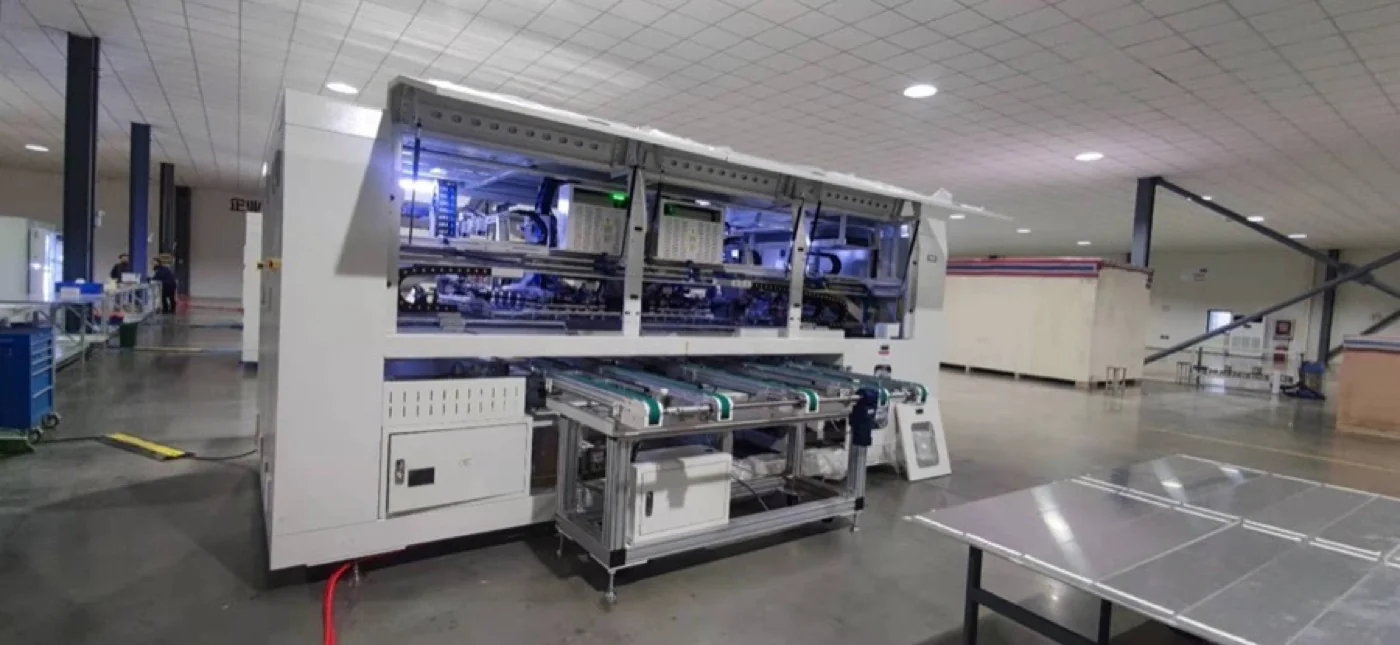
The risks change once a business owns machines like this, where fixed capacity, yield ramp and utilisation decide whether it survives.
Why Manufacturers Fail — and This Part Is Different
Manufacturing failure has its own logic. The industry is capital-intensive, cyclical, policy-exposed and characterised by falling prices. Each of those is manageable alone; together they punish anyone who gets the timing wrong.
Is the Industry Actually Struggling?
The honest answer is that the industry is always struggling somewhere, because it is structurally cyclical. Demand grows over the long term, but capacity grows in steps, and the mismatch between a step-wise supply curve and a smooth demand curve produces a regular cycle of margin compression followed by consolidation.
What is genuinely different in the current period is the pace of technology transition. The industry has moved from multi to mono, then to PERC, then to TOPCon, and is now moving toward back-contact routes. Each transition rewards whoever ramps first and penalises anyone holding capacity in the outgoing technology. Our notes on the back-contact roadmap and on what changes structurally between TOPCon and BC cover the technical side of that shift.
A transition period is the most dangerous time to be a manufacturer and the most dangerous time to be a buyer of equipment, because the specification that is right today may be the outgoing one in three years. It is also, for the same reason, the best time to build a line — if you build it for the format that is coming rather than the one that is going.
What Makes a Manufacturing Business Survivable
Looking at who survives rather than who fails gives a clearer set of rules. The survivors tend to share four characteristics.
- Capacity discipline. They expand against committed demand rather than against a forecast, and they accept losing volume in a boom to avoid carrying it through a bust.
- A cost position they can defend. Usually a combination of scale, yield and supply chain location rather than a single advantage.
- Cash conversion that works. They collect faster than they pay, which for a manufacturer means deposit terms on orders and disciplined credit to customers.
- Equipment flexibility. Lines specified to handle more than one cell format or technology survive a transition; lines specified for exactly one, at the cheapest possible price, do not.
That last point is the one we see most directly, because it is decided at the point of purchase. A line bought to make exactly today’s product at today’s price is a bet that nothing changes. Our guide to starting a module business and the breakdown of what lines cost at different capacities both come back to the same question: what does this configuration let you make in three years?
What This Means If You Are Planning to Build Now
A high failure rate in the industry is not a reason to avoid it, but it is a reason to be specific about what you are protecting against. The pattern above translates into a short list of things to settle before committing capital.
The reason this matters is that the failure mechanisms are knowable in advance. Almost nobody in this industry fails because of a surprise they could not have anticipated. They fail because capacity was committed against a price that did not hold, or because the cash to reach mature yield was not there, or because the line could only make the product that was fashionable three years earlier. All three are decisions, and all three can be made differently.
Frequently Asked Questions
Why do so many solar companies go out of business?
For installers and distributors the cause is usually financial: thin margins, long receivables, inventory that falls in value, and demand that moves with interest rates and policy. For manufacturers it is usually timing: capacity built ahead of demand, prices falling faster than costs, and a yield ramp that consumed more capital than planned. These are different problems that get reported as one industry statistic.
Is the solar industry currently struggling?
It is always struggling somewhere, because capacity is added in large steps while demand grows more smoothly. That mismatch produces a regular cycle of margin compression and consolidation. What makes the current period harder is the pace of technology transition, which penalises anyone holding capacity in the outgoing technology.
Is solar panel manufacturing profitable?
It can be, but the margin is thin and it depends on cost position rather than on price. Profitability comes from buying cells well, running at high utilisation, keeping yield high and converting cash quickly. A factory that is well equipped but running at low utilisation or low yield is not a profitable factory regardless of how good the machines are.
What is the biggest risk when starting a module factory?
Most first-time builders underestimate the working capital, not the equipment. Cells, encapsulant, glass and ribbon must be bought before the first module is sold, and customers pay on terms. A factory that is fully equipped and out of cash is a common and entirely avoidable failure.
How long does it take to reach full yield on a new line?
Longer than commissioning takes, and it is the single most frequently underestimated line in the business plan. Yield climbs as operators learn the process, as defect signatures become recognisable and as the soldering and lamination profiles are tuned to the actual cell and materials in use. Budget for that period explicitly.
Does buying cheaper equipment reduce the risk?
It reduces the capital at risk and often increases the operating risk, because cheaper equipment usually means less process margin, slower changeover between formats and more dependence on operator skill. The relevant question is not the purchase price but the cost per good module over the life of the line.