
Ooitech has delivered four solar panel production lines in Egypt since 2014. What Egyptian buyers ask, and how much space each capacity needs.
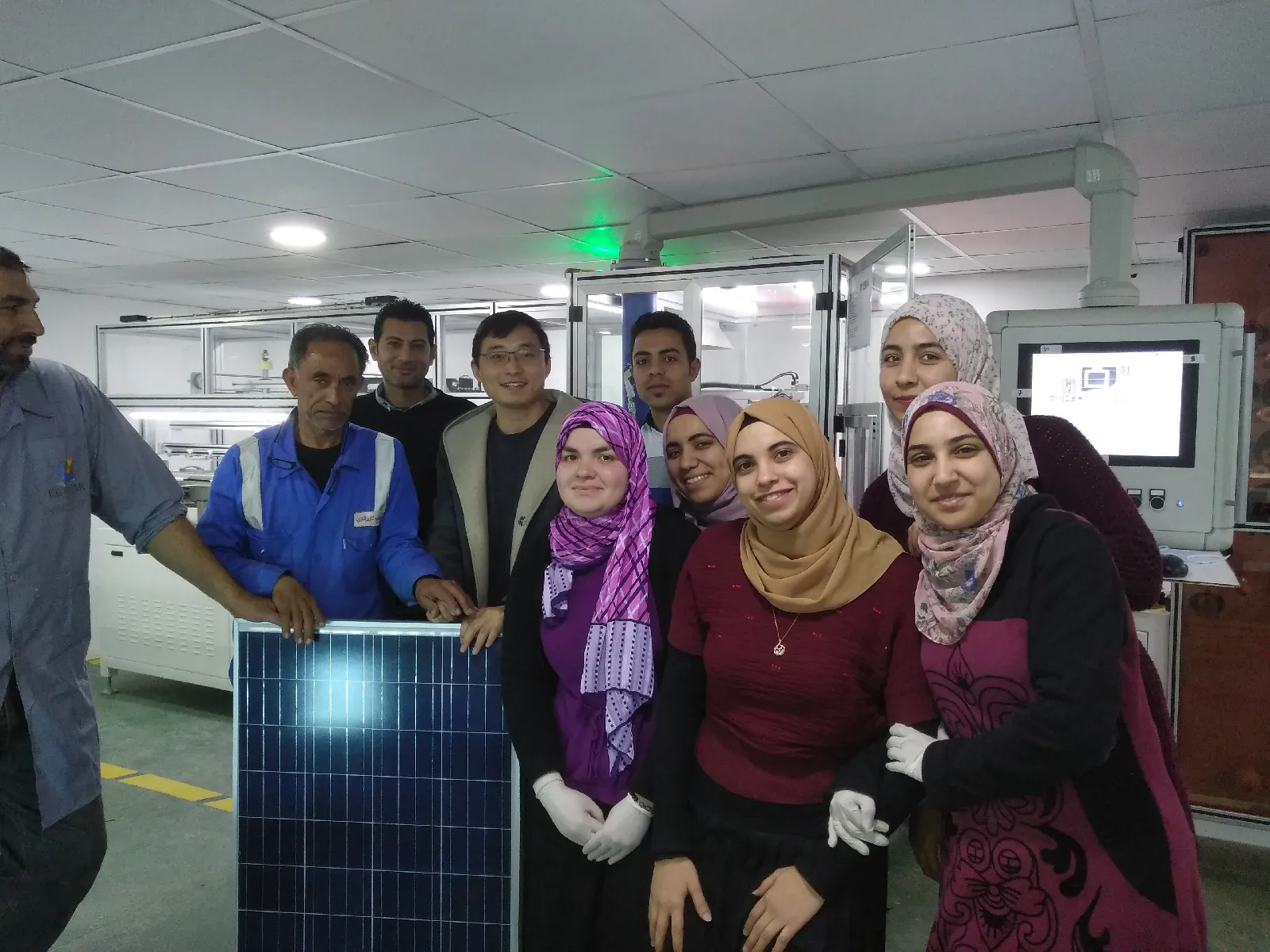
Egypt's First Full Automatic Solar Panel Production Line from China — Delivered by Ooitech
In 2014, Ooitech proudly delivered a full automatic solar panel production line to an Egyptian customer, making them the very first company in Egypt to introduce solar panel manufacturing equipment and technology from China. This landmark project represented a significant milestone not only for Ooitech but also for the entire Egyptian solar energy industry. By partnering with Ooitech, the Egyptian customer gained access to cutting-edge manufacturing technology, world-class equipment, and comprehensive technical support, enabling them to produce high-quality solar panels domestically and reduce dependence on imported solar modules.
This pioneering project demonstrated Ooitech's capability to deliver complete turnkey solar panel production solutions to international markets, including equipment design, manufacturing, shipping, installation, commissioning, operator training, and ongoing after-sales service. The successful deployment in Egypt has since served as a benchmark reference for solar panel factory projects across the Middle East and North Africa (MENA) region.
Full Automatic Production Line Equipment Overview
Complete Equipment Configuration
The full automatic solar panel production line delivered to Egypt included a comprehensive set of manufacturing equipment covering every stage of solar module assembly, from cell handling to final testing and packaging.
| Equipment | Function |
|---|---|
| Glass Loading Machine | Automatic glass substrate loading and positioning |
| EVA/TPT Cutting Machine | Precision cutting of encapsulant and backsheet materials |
| Solar Cell Laser Cutting Machine | High-precision cell cutting for customized sizes |
| Solar Cell Tabber Stringer | Automatic cell soldering and string interconnection |
| Solar Cell Layup Machine | Automated cell string layout on glass substrate |
| Bussing Machine | Bus ribbon soldering and interconnection |
| EL Tester (Pre-Lamination) | Electroluminescence defect inspection before lamination |
| Solar Panel Laminator | High-temperature vacuum lamination for module encapsulation |
| Framing Machine | Automatic aluminum frame installation |
| Glue Dispensing Machine | Sealant application for frame bonding |
| EL Tester (Post-Lamination) | Final electroluminescence quality inspection |
| IV Tester / Sun Simulator | Solar panel power output and performance measurement |
Why Ooitech Was Chosen as the First Equipment Supplier to Egypt
Proven Technology and Reliability
The Egyptian customer conducted extensive research and evaluation before selecting Ooitech as their equipment and technology partner. Several key factors contributed to this historic decision:
Project Impact and Application Significance
A Milestone for Egypt's Solar Energy Industry
This project holds significant importance for Egypt's renewable energy development and the broader MENA region:
Since this pioneering 2014 project, Ooitech has continued to expand its global footprint, delivering solar panel production lines and equipment to customers across Asia, Africa, the Middle East, South America, and beyond. The Egypt project remains one of the most significant milestones in Ooitech's history, demonstrating the company's dedication to empowering solar energy manufacturers worldwide.
Four Egyptian Solar Panel Projects Ooitech Has Delivered
The 2014 line was the start, not the whole story. Ooitech has supplied Egyptian manufacturers four times across seven years, and each project answered a different question about building a solar panel factory in Egypt.
| Year | Customer | What was delivered |
|---|---|---|
| 2014 | First Egyptian adopter | Egypt's first full automatic solar panel production line imported from China, from equipment design through installation, commissioning and operator training |
| 2015 | Power Field | First solar module manufacturing facility in the Red Sea Suez region: a complete semi-automatic line plus raw materials, from cell cutting and stringing to lamination and framing |
| 2015 | Global Energy | A 10 MW semi-automatic line, which let the customer both manufacture modules and launch an EPC business installing systems with their own panels |
| 2021 | Egyptian PV manufacturer | Upgrade from semi-automatic stringing to a full automatic tabber stringer, to raise throughput and soldering quality |
The progression matters if you are planning a factory now. The 2014 project proved a full automatic line could run in Egypt. The 2015 projects proved a semi-automatic line was enough to start. The 2021 upgrade shows what happens three to five years later, when volume outgrows the first line. Detail on each project: the 2014 full automatic line, the Red Sea Suez factory, the 10 MW Global Energy line and the 2021 stringer upgrade.
What Egyptian Buyers Ask Before Choosing a Line
These are the questions that actually come up in our Egyptian enquiries, not a generic checklist.
"I am new to this field and need your guidance."
Most Egyptian enquiries we receive are first-time manufacturers, often from an EPC, trading or construction background rather than from module manufacturing. That changes the buying sequence. Instead of quoting a machine list, the first step is deciding the annual capacity, the module type, and whether the line will be semi-automatic or fully automatic. A 10 MW semi-automatic line is a common first factory; 60 MW and above is where full automation starts to pay for itself.
"What factory size do I need?"
One Egyptian customer told us their building was 8,000 m² and asked what it would support. The answer was a 300 MW line. Floor area is usually the constraint that decides capacity, so it is worth stating your building size in the first enquiry rather than the last.
"We are at the steel structure stage. Can we start equipment selection?"
Yes, and it is better to start early. Equipment selection, layout and utility planning (power, compressed air, lamination heat transfer) all affect the building. A factory that finalises the equipment list before the roof goes on avoids rework.
"What is the raw material cost per watt?"
This comes up in almost every serious Egyptian enquiry, because material cost, not equipment cost, decides whether the factory is competitive. Ooitech supplies raw materials as well as machines, so the two can be quoted together rather than separately.
Choosing Capacity: Why 100 MW and 150 MW Cost Almost the Same
One piece of advice we give repeatedly is to skip 100 MW. When an Egyptian customer asked for a 100 MW proposal, the recommendation was to compare it against 150 MW instead, because the equipment cost is almost the same while annual output is 50% higher. The difference is usually not the machines themselves but how the line is balanced.
The same logic applies at the entry level. A 10 MW semi-automatic line and a 20 MW semi-automatic line are close in equipment scope; what changes is throughput and the space and labour around it.
| Line | Output | Power | Building | Workers |
|---|---|---|---|---|
| 10 MW semi-automatic | 14 panels/hour | 100-150 kW | about 700 m² | 12-15 |
| 20 MW semi-automatic | 28 panels/hour | 100-150 kW | about 1,000 m² | 16-20 |
| 300 MW | project dependent | project dependent | 8,000 m² building | project dependent |
For a budget view across capacities, including actual quotation sheets, see the solar panel production line cost by capacity. For the equipment sequence behind these numbers, see what machines are used to make solar panels.
Frequently Asked Questions
Has Ooitech supplied equipment to Egypt before?
Yes, four times. A full automatic line in 2014, two separate projects in 2015 (Power Field in the Red Sea Suez region and a 10 MW line for Global Energy), and a tabber stringer upgrade in 2021.
What is the smallest solar panel production line I can start with?
A 5 MW or 10 MW semi-automatic line is the usual entry point. A 10 MW line runs about 14 panels per hour, needs roughly 700 m² and 12-15 workers, and draws 100-150 kW.
How long does delivery to Egypt take?
For the smaller semi-automatic lines, production can start within about 10 to 40 days of the deposit depending on capacity. Exact lead time is confirmed per project in the quotation.
Do you supply raw materials as well as machines?
Yes. Ooitech supplies solar cells, ribbon, encapsulant film, backsheet, glass, frames and junction boxes alongside the production line, so material cost per watt and equipment cost can be evaluated together.
Can the line produce the newer cell formats?
Yes. Lines can be configured for traditional 5BB/6BB cells or for 9BB/10BB/12BB 166/182/210 half-cut cells, PERC, TOPCon and glass-glass modules. State the cell format in the enquiry, because it determines the stringer configuration.
Contact Ooitech — Your Trusted Solar Panel Production Line Partner
Start Your Solar Panel Factory Project Today
Whether you are planning to build a new solar panel factory or upgrade your existing production line, Ooitech is ready to provide you with a complete solution tailored to your specific requirements. From 5MW to 1GW capacity, Ooitech covers equipment for PERC, TOPCon, IBC, ABC, HPBC, Shingled, Flexible, and Thin Film solar panel production.
Get in Touch with Ooitech:
Useful Resources:
- Watch our MBB Full Automatic Solar Panel Production Line in action: YouTube Video
- Subscribe to our YouTube channel for more solar factory insights: Ooitech YouTube Channel
- Download our product catalogue: Ooitech Catalogue
- Download Ooitech company profile: Company Profile
Contact Ooitech today and let us help you build your solar panel manufacturing success story — just like we did for the first solar panel factory in Egypt!
If you are planning your first factory in the region, start with how to start a solar panel manufacturing business, which sets out the decision order we followed on each of the projects above.