
How a PV module laminator machine works: the vacuum stages, EVA crosslinking window, temperature and pressure profile, and the defects each stage prevents.
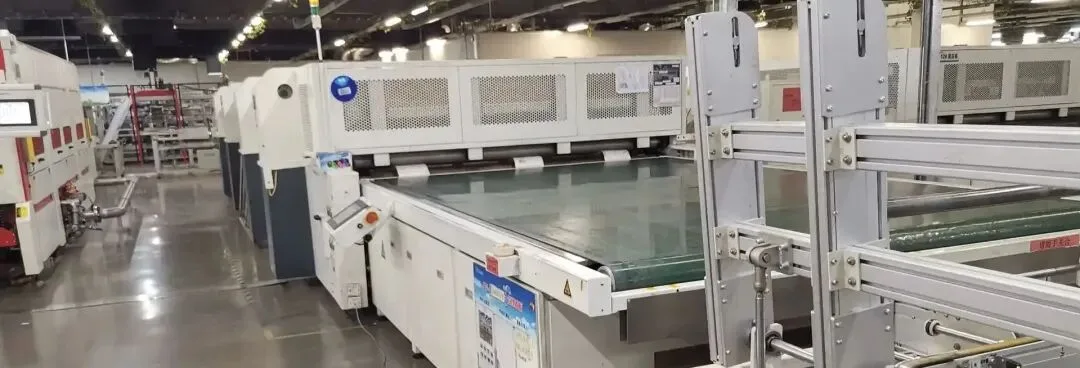
Quick answer: A solar panel laminator is the machine that bonds the module stack — front glass, EVA encapsulant, the interconnected cell string, a second EVA layer and the backsheet — into one sealed, void-free unit. It does this under vacuum and heat in a multi-stage cycle. First the chamber evacuates to remove trapped air, then pressure is applied while the platens heat the stack, and finally the module is held at temperature long enough for the EVA to crosslink fully. The EVA thermal window is narrow: crosslinking proceeds around 150°C, while the process must avoid the 120°C region where the encapsulant is still fluid and prone to bubbles, and the cool-down must be controlled to prevent cell shift. Temperature uniformity within about 2°C across the platen is the practical requirement, since a cold corner leaves uncured EVA and a hot spot degrades it.
PV Module Manufacturing · by Jerry, Ooitech
What a Solar Panel Laminator Does
The vacuum system that sits behind the lamination cycle — pump types, their roles and the EVA thermal window that sets the deadline — is covered in laminator vacuum pumps, the EVA window and how the pump set is configured.
The solar panel laminator is the machine that turns a stack of loose layers into one sealed module. On the PV module encapsulation line it fuses the laid-up materials into a single unit: under set temperature, vacuum and pressure, a solar panel laminator machine heat-presses and bonds the prepared cells, busbars and encapsulant films together. The core objectives of this process include:
The machine itself sits between materials and process: the encapsulant film you choose sets the process window, and the lamination stage determines what the finished laminate looks like. For the selection criteria, see how to choose the right solar module laminator; for the specific faults, see frame jumping and laminate bubbles. At line level, the laminator is one station in the sequence described in solar panel manufacturing machines.
Technical Parameters
The Laminator's Critical Position on the Production Line
Before looking at numbers, it helps to understand why this station matters so much. Lamination quality directly relates to the module's long-term reliability (PID resistance, damp-heat endurance, UV and mechanical load capability) and service life of over 25 years. The lamination cycle is also relatively long (typically 8-15 minutes per cycle), so equipment efficiency and stability have a decisive influence on whole-line capacity. Initial investment, running energy consumption and periodic maintenance all form an important part of module production cost.
| Parameter | Typical Specification |
|---|---|
| Lamination cycle time | 8-15 min per cycle |
| Temperature control accuracy | ±1-2°C |
| Chamber 1 temperature | approx. 110-120°C |
| Chamber 2 temperature | 140-150°C |
| Working / main vacuum level | 40-100 Pa (or lower) |
| Chamber 1 vacuum time | 300-400 s |
| Chamber 2 vacuum time | approx. 50-120 s |
| Chamber 2 holding time | approx. 400-600 s |
| Cooling target temperature | below 50°C |
| Heating method | Oil heating / Electric heating |
| Pressure method | Air bag / Diaphragm (silicone membrane) |
| Chamber structure | Double-deck three-chamber / double-chamber |
| Silicone sheet service life | 6000-8000 cycles |
Technical Advantages
Main Equipment Systems and Working Principle
A laminator usually integrates several core systems working together:
Typical Lamination Process Steps (Air-Bag Type Example)
- Loading: The laid-up module is conveyed into the opened first chamber.
- Lid Closing: The upper lid descends, closes with the lower chamber and presses the sealing strip.
- Vacuuming: The vacuum pump starts, quickly extracting chamber air to the set vacuum level (chamber 1 vacuum time usually 300-400 s) and removing most gas from the module.
- Heating & Melting: Chamber 1 holds about 110-120°C; the incoming module is passively heated and the film melts (synchronized with vacuuming).
- Pressurizing: After vacuuming, the air bag/diaphragm is inflated, applying uniform pressure to the molten module through a silicone plate. Under combined pressure and vacuum, the EVA flows to fill voids and bubbles are expelled.
- Holding Pressure & Vacuum: Maintained at set temperature, high vacuum and pressure for a period (usually 300-400 s) to fully remove bubbles.
- Vacuum & Pressure Release: When time is up, air is slowly introduced and bag pressure released to prevent deformation or internal stress from sudden pressure change.
- Lid Opening & Transfer to Chamber 2: The lid rises and the module is conveyed to chamber 2.
- Chamber 2 Operation: Set at 140-150°C. As bubbles were removed in chamber 1, vacuum time is short (about 50-120 s) but holding time is longer (about 400-600 s) to ensure full crosslinking. After vacuum release and lid opening, the module enters the cooling chamber (chamber 3).
- Cooling: Cooling water in the chamber 3 base plate lowers the module to a safe range (e.g. below 50°C) to stabilize the structure. Units without a third chamber often add air cooling at atmospheric pressure.
- Unloading: The lid rises and the laminated module is sent to the next process such as trimming.
Product Application
Key Control Parameters of the Lamination Process
The laminator is applied as the central encapsulation station across virtually all crystalline-silicon and many thin-film module lines, and getting these parameters right is what makes it work in real production:
Equipment Maintenance Essentials
Regular maintenance is key to safeguarding equipment performance and life:
The laminator is undoubtedly the heart of PV module manufacturing; its performance directly determines encapsulation quality and long-term reliability. As PV technology evolves toward higher efficiency, larger sizes, thinner cells and double-glass structures, the laminator faces higher demands in temperature uniformity, vacuum performance, pressure control accuracy, and automation and intelligence.
Ooitech's View
As a global solar panel production line supplier, Ooitech believes the laminator is where module reliability is truly won or lost: with thin wafers and double-glass designs now mainstream, the margin between good and poor temperature uniformity, vacuum stability and pressurization control has narrowed dramatically, and a well-matched three-chamber laminator is no longer a luxury but a baseline requirement. From our turnkey module-line experience, we find that pairing precise PLC-driven process recipes with disciplined silicone-sheet and seal maintenance does more for yield than chasing peak speed alone. For more real-world footage from solar module factories, you are welcome to follow and subscribe to the Ooitech YouTube channel at www.youtube.com/ooitech.
Related reading: how machine prices are built and where the laminator sits in the line.